


Types of Bitumen Packaging – Complete Guide
A professional guide to bitumen packaging from Iran, including real photos and container loading capacity.
Choosing the right packaging method is essential for cost-effective importation of bitumen. At JANIS Business Group, we offer all standard packaging types used in international trade, optimized for different project sizes and infrastructure levels.
1. Steel Drums (Barrels)

The most widely used packaging for small to medium orders. Ideal for buyers without bulk storage or heating systems.
- Standard Size: 180 kg (~210 L) — Most Common
- Other Sizes: 150 kg, 200 kg
- Material: Galvanized steel with full-open top lid
- Palletized: Yes – 4 drums per pallet (EUR/EPAL size)
- Shrink-Wrapped: For moisture protection
- Best For: Roofing, waterproofing, small paving jobs, remote areas
✅ Advantages: Easy handling, no special equipment needed, ideal for non-industrial sites.
❌ Limitations: Higher cost per ton than bulk; requires labor to open and melt.
2. Jumbo Bags (FIBCs)

Heavy-duty woven polypropylene bags used for mid-volume shipments.
- Common Capacities: 800 kg, 1,000 kg, 1,200 kg
- Palletized: Yes – on wooden pallets (1,000×1,200 mm)
- Top Type: Open-top (for fast melting) or closed with spout
- Shrink-Wrapped: Yes – for moisture protection
- Best For: Medium-sized projects, asphalt plants, developing markets
✅ Advantages: Cost-effective vs. drums; space-efficient; compatible with most melting tanks.
❌ Limitations: Requires cutting and heating setup; not ideal for very cold climates.
3. Oxidized Bitumen (Rass) – 25kg Bags

Oxidized bitumen (Rass) is a by-product of distillation, used in industrial applications such as roofing, pipe coating, and adhesives.
- Form: Solid flakes or granules
- Packaging: 25 kg kraft paper or PP woven bags with inner PE liner
- Palletized: 40 bags per pallet (1,000 kg)
- Container Loading: Up to 20 MT in 20ft container (with pallets)
- Best For: Waterproofing, anti-corrosion, construction chemicals
✅ Advantages: Fast melting, excellent adhesion, suitable for blending.
❌ Limitations: Not suitable for road paving; brittle at low temperatures.
4. Flexitank (Liquid Bitumen)
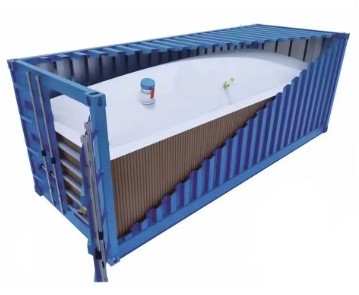
A flexible tank liner installed inside a 20ft dry container. Used for shipping hot liquid bitumen under controlled temperature.
- Capacity: 18–20 MT (depending on density)
- Tank Material: Multi-layer heat-resistant polymer
- Heating Required: Must be kept above 130°C during transit
- Unloading Method: Pumped out via bottom valve
- Best For: Buyers with storage tanks and heating systems
✅ Advantages: No return cost; high volume; clean unloading.
❌ Limitations: Single-use; requires temperature monitoring.
5. Bitucontainer (Insulated Reusable Container)

An advanced, reusable solution for long-distance shipment of hot bitumen. The Bitucontainer is a permanent insulated system built into a 20ft ISO container, maintaining temperature without external heaters.
- Capacity: 18–22 MT
- Structure: Permanent flexitank + mineral wool insulation
- Reusability: Designed for multiple trips
- Temperature Control: Maintains 130–150°C for up to 14 days
- Unloading: Bottom valve with pump
- Best For: Frequent importers needing reliable hot bitumen supply
✅ Advantages: Reusable, reduces logistics cost over time, consistent quality.
❌ Limitations: Higher initial investment; requires maintenance between uses.
6. Loose / In Bulk

For large-scale importers, bitumen can be shipped in bulk form directly into railway wagons or open vessels.
- Form: Solid slabs or hot liquid
- Port of Loading: Bandar Abbas, Iran
- Minimum Order: 5,000 MT+
- Incoterms: FOB, CIF, CFR
- Best For: Government tenders, highway authorities, asphalt producers
✅ Advantages: Lowest cost per ton; fastest delivery for mega projects.
❌ Limitations: Requires terminal with unloading cranes and storage tanks.
📦 Container Loading Capacity
| Packaging | 20ft (With Pallets) | 20ft (Without Pallets) | 40ft (With Pallets) | 40ft (Without Pallets) |
|---|---|---|---|---|
| Drum (180 kg) | 80 drums (14.4 MT) |
110 drums (19.8 MT) |
137 drums (24.66 MT) |
150 drums (27.0 MT)* |
| Oxidized Bitumen (25 kg Bag) | 20 pallets × 40 = 800 bags (20 MT) |
Up to 21 MT | Not applicable | Not applicable |
| Jumbo Bag (1,000 kg) | 20 bags (20 MT) |
N/A | 24 bags (24 MT) |
N/A |
| Jumbo Bag (1,200 kg) | 18 bags (21.6 MT) |
N/A | 20 bags (24.0 MT) |
N/A |
| Flexitank (Liquid) | 1 unit (18–20 MT) |
N/A | Not applicable | Not applicable |
| Bitucontainer (Hot Box) | 1 unit (18–22 MT) |
N/A | Not applicable | Not applicable |
* Note: Maximum gross weight for containers is limited by maritime regulations to ~24–28 MT depending on route and port. Actual load must comply with carrier requirements.
✅ How to Choose the Right Packaging?
Under 200 MT? → Use Drums or Rass Bags
200–5,000 MT? → Choose Jumbo Bags or Flexitank
Over 5,000 MT? → Optimize with Bulk or Bitucontainer
At JANIS Business Group, we help you select the best packaging method based on your project needs, destination port, and available infrastructure.
© 2026 JANIS Business Group. All rights reserved. | This guide is for informational purposes only.